Scholars have studied and labeled the massive movement of Black citizens moving to the North from the South during the turn of the century, but rarely have they studied the significant amount of Black citizens that moved to southern metropolitan areas. The Great Migration lasted from 1910 to 1970 and created a drastic shift in race population throughout the country. While the primary focus in most academic studies focus on aspects of northern cities due to this area seeing the most drastic change, the South shows a significant shift in population in the Metropolitan areas.1 This change shows that southern migration changed the South itself, not just the North due to the instate migration occurring during this period. Analyzing the state of Georgia shows this migration pattern to be important on an instate level.
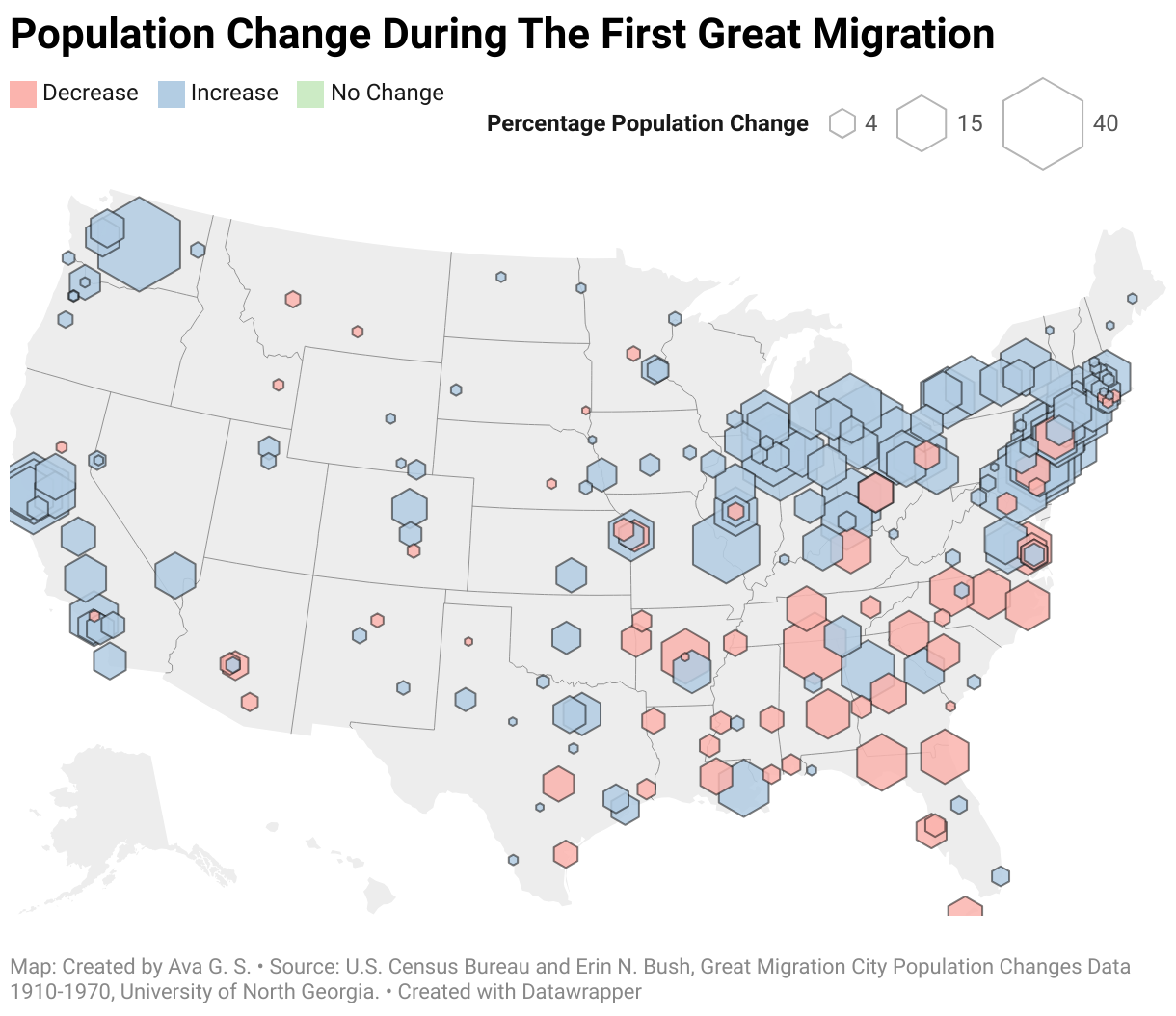
By looking at a map of the population changes in The Great Migration, the northern metropolitan areas clearly increase the most; however, a closer look at southern states shows an increase in each state’s major metropolitan areas.2 Georgia in particular increased in the center of the state while a minimal amount of decrease is seen south of the center and also near the Florida-Georgia line. This shows that while many of Georgia’s Black population left Georgia, many also moved within the state for a better opportunity. In fact, Atlanta showed a 16.7% increase in population while Macon and Columbus combined decreased 13.4%.3 Georgia’s metropolitan cities increasing during this migration wave highlights how many Black southerners did not or could not leave the south but still chose to leave their situation behind for something better. In fact, studies shows that migrants who moved north and migrants who moved instate varied in economic and social status gain.4 While the economic status of Black migrants in both Northern cities and Southern cities show a varying degree of status change, the pressure of labor issues explains why drastic social change was no applicable with migration. During the peak of the migration, political unrest led by senator elect reportedly aligned racial unrest with the labor movement occuring in unions.5 The social unrest from labor unions and racial disparity continuing in the country, explains the reasoning behind why many stayed instate. No matter the city, Black citizens would continue to face the challenges of a racially divided nation. Georgia exemplifies how the Great Migration patterns were diverse and complicated by the reality of the effects of moving instate.
Bibliography
U.S. Census Bureau and Erin N. Bush, Great Migration City Population Changes Data 1910-1970, University of North Georgia.
Frey, William H., Kao-Lee Liaw, Richard Wright, and Michael J. White. “Migration within the United States: Role of Race-Ethnicity [with Comments].” Brookings-Wharton Papers on Urban Affairs, 2005, 207–62.
Eichenlaub, Suzanne C., Stewart E. Tolnay, and J. Trent Alexander. “Moving Out but Not Up: Economic Outcomes in the Great Migration.” American Sociological Review 75, no. 1 (February 1, 2010): 101–25. https://doi.org/10.1177/0003122409357047.
Georgia, Digital Library of. “Atlanta Georgian. (Atlanta, Ga.) 1912-1939, April 26, 1914, Three Stars Extra, Image 4.” Accessed November 19, 2024. https://gahistoricnewspapers.galileo.usg.edu/lccn/sn89053729/1914-04-26/ed-3/seq-4/#words=LABOR+labor+Labor+laborers.
Humanities, National Endowment for the. “Atlanta Georgian. [Volume] (Atlanta, Ga.) 1912-1939, August 14, 1914, Night Edition, Image 5,” August 14, 1914.
- In regards to racial and ethnic spatial disparity occurring in cites with economic opportunities. For more context on the social significance of race population changes see Frey, William H., Kao-Lee Liaw, Richard Wright, and Michael J. White’s section 1 of “Migration within the United States: Role of Race-Ethnicity.” [↩]
- Map by Ava G. S. using population data from the U.S. Census Bureau. This dataset contains the calculated population percentage changes of the African American population in the U.S. excluding Alaska and Hawaii because of unavailable data. Notice the increase symbols in Georgia in comparison the the decrease symbols. [↩]
- Data from the U.S. Census Bureau and Erin N. Bush, Great Migration City Population Changes Data 1910. [↩]
- For specifics of varying benefits and disadvantages for each migration group, see page 111-113 of Eichenlaub, Suzanne C., Stewart E. Tolnay, and J. Trent Alexander’s “Moving Out but Not Up: Economic Outcomes in the Great Migration.” American Sociological Review 75, no. 1 [↩]
- Atlanta Georgian., April 26, 1914, Three Stars Extra, Page 6. [↩]